A headline with a hook.
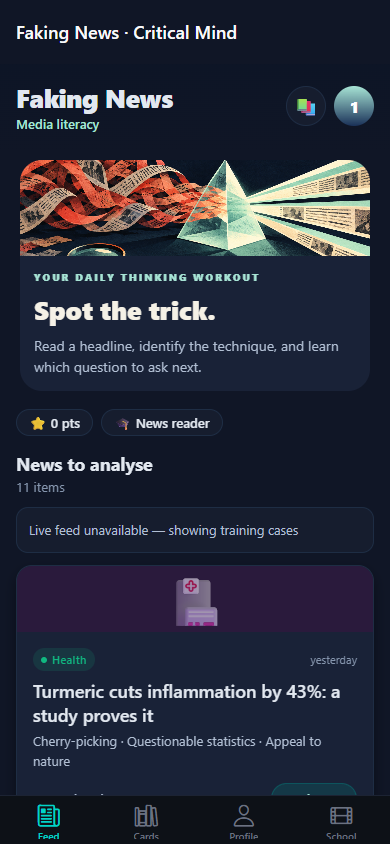
Start with a short news example. Notice what the wording makes you feel or assume.
CRITICAL MIND / A LEARNING GAME
Headlines compete for your attention.
Learn to spot the tricks behind them.
Short, playable exercises turn manipulation techniques into something you can recognise, question and discuss.

FROM REACTION TO REFLECTION
ONE SIMPLE LEARNING LOOP
Start with a short news example. Notice what the wording makes you feel or assume.
Decide whether a technique appears in the text, using clear Yes / No controls or the card interaction.
Open an explanation, inspect an example and practise the technique again.
A DECK YOU CAN ACTUALLY READ
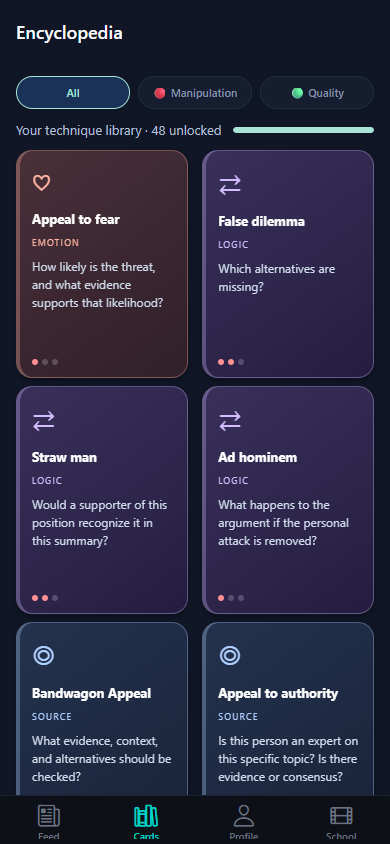
Six visual families separate source, logic, emotion, framing, evidence and language. The question matters more than the label.
“Experts say…”
Who are the experts? Can you find their original work?
ILLUSTRATIVE EXAMPLE · ASK, DON'T ASSUME“Either we act, or everything fails.”
Are these really the only options?
ILLUSTRATIVE EXAMPLE · ASK, DON'T ASSUME“Your family could be next.”
What evidence supports the threat?
ILLUSTRATIVE EXAMPLE · ASK, DON'T ASSUME“A monstrous betrayal.”
What changes if the emotional label is removed?
ILLUSTRATIVE EXAMPLE · ASK, DON'T ASSUME“The rate rose by 42%.”
Compared with what baseline and over which period?
ILLUSTRATIVE EXAMPLE · ASK, DON'T ASSUME“Everyone knows this is true.”
Who is included in “everyone”, and what are the exceptions?
ILLUSTRATIVE EXAMPLE · ASK, DON'T ASSUMEINSIDE THE WORKING APP
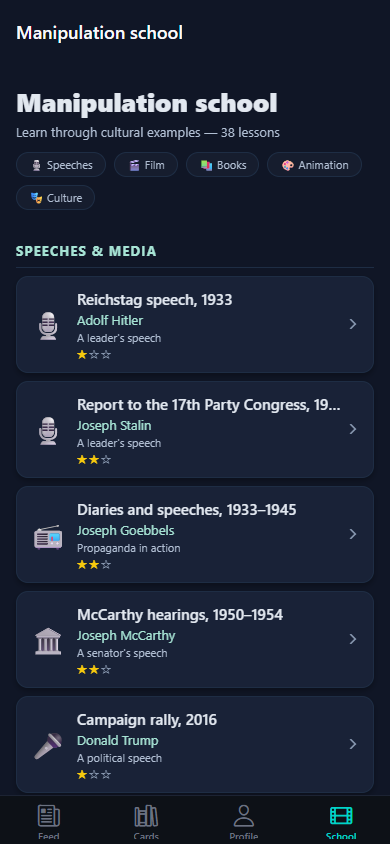
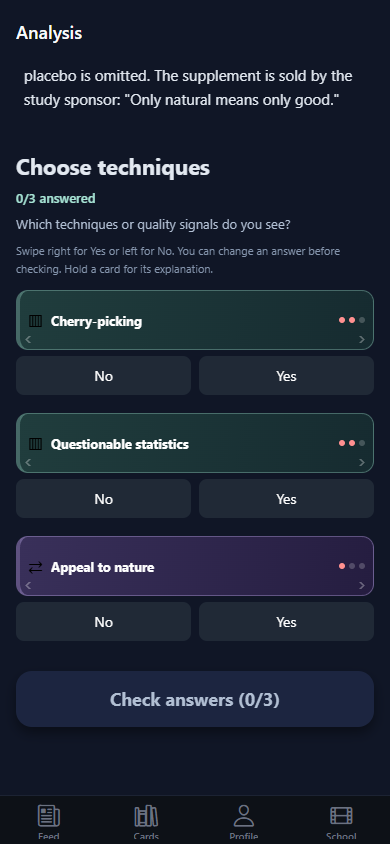
Actual screens from the current English browser prototype.
FOR PEOPLE WHO TEACH AND LEARN
Build a habit of pausing before accepting or sharing a persuasive claim.
Use concrete examples and verification questions to start a media-literacy discussion.
Explore the prototype as a starting point for learning design and independent evaluation.
TRY IT FOR YOURSELF
Working prototype. Live feeds depend on external sources. Exercises are practice, not a validated measure of critical-thinking ability.
Explore the reading companion →