A playable prototype
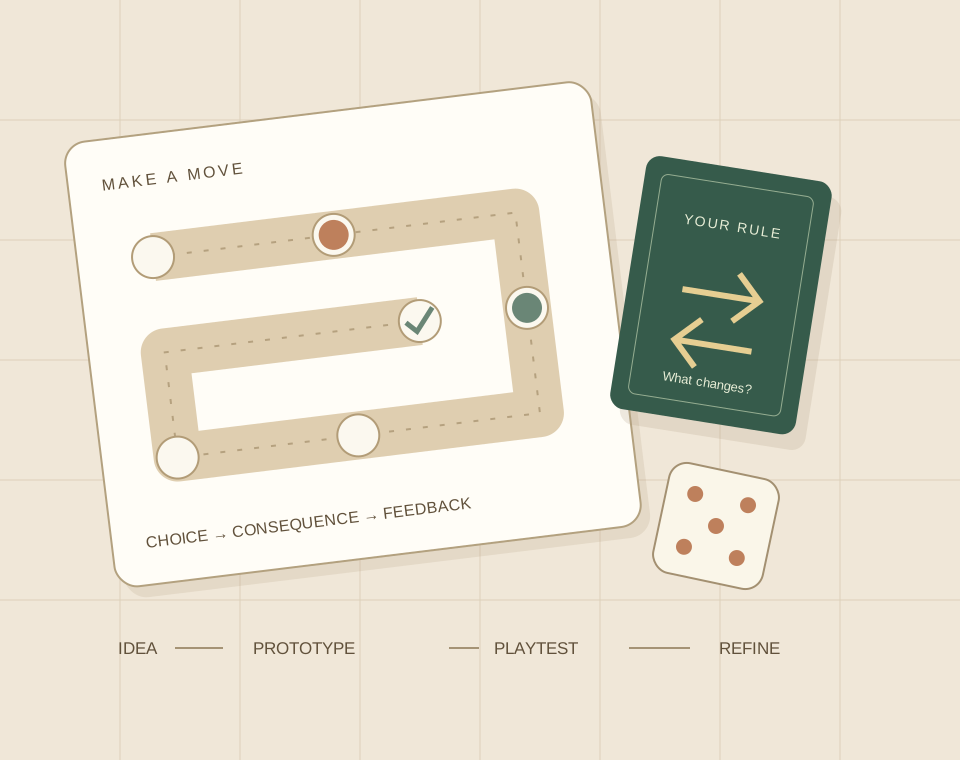
A board game, card game, quest or role-playing scenario with a clear beginning, choices and an ending.
Games & Gamification / A PRACTICAL COURSE
Turn an idea into a playable game. Design the mechanics, build a prototype, test it with others and improve it through feedback.
YOUR COURSE PROJECT
A board game, card game, quest or role-playing scenario with a clear beginning, choices and an ending.
A concise ruleset and the components or scenario needed to put the game into play.
Playtest notes, specific changes and a clear explanation of why you made them.
THE IDEA
What makes a decision interesting? Why does one rule create cooperation and another create competition? How can a game help someone learn?
Bring a game idea, a learning goal or a shared experience you want to create. You will turn it into rules and decisions, build a small version and watch other people play it. Their choices become the evidence for your next design decision.
Gamification extends the same questions into learning, teamwork and other activities: what do people do, why does it matter, and what feedback helps them move forward?
THE PROGRAMME
A seven-part learning sequence, from the first experiment to a game others can understand and run.
Goals, rules, constraints, meaningful choices and feedback. Make a small prototype and let someone else play it.
Explore board games, card games, quests, role-playing and social games. Pitch an idea that can become a playable experience.
Define the players, the goal and the basic turn. Use simple components to build a version that can be tested.
Shape the core loop. Work with resources, uncertainty, information, roles and negotiation to give choices consequences.
Connect mechanics with emotion, story and participation. Establish clear boundaries for role-playing and social experiences.
Watch a new group play. Find confusing rules, long waits and dominant strategies; improve the game and test it again.
Prepare the components, concise rules and a short introduction. Run the game for others and explain what changed through testing.
A LESSON IN ACTION
The working rhythm is practical: make a small game, let someone else try it and use what happens to decide what to change.
Choose a goal, a constraint and an action. Use paper, cards, tokens or a short scenario to make the choice happen.
Notice where they hesitate, negotiate, take a risk or wait. Write down what actually happened.
Choose one problem, revise the game and test again. Explain which change improved the experience and why.
DESIGN WITH A PURPOSE
Trade, shared resources and promises create space for bargaining and decisions about trust.
Different perspectives make players ask questions, interpret signals and act with incomplete knowledge.
Visible consequences give players something to learn from — and designers something to improve.
Mechanics are chosen for the experience they create. What players actually do during a test matters more than what the designer intended.
WHAT YOU MAKE
PRACTICAL QUESTIONS
A playable game prototype, a concise ruleset and a record of changes made after playtesting. The project can take the form of a board game, card game, quest or role-playing scenario.
The course uses simple prototypes: paper, cards, tokens and scenarios. Programming is not required to explore the design process.
You start from the experience or learning goal you want to create, then choose mechanics that support it. The course applies that design process to games and to activities such as learning and teamwork.
BRING THE COURSE TO YOUR GROUP
Request the programme directly from its author. Tell me who will take part and what you want them to learn; we can discuss the scope and format for your group.
Request the programmeInclude your group size, learning goals and preferred dates.
Investigate one mystery through different ways of knowing. Compare explanations, test claims and build a conclusion you can defend.
Explore the course →