An investigation file
Record the question, the available sources and the gaps you still need to investigate.
Ways of Knowing / A PRACTICAL COURSE
Investigate one mystery through different ways of knowing. Compare explanations, test claims and build a conclusion you can defend.
YOUR COURSE PROJECT
Record the question, the available sources and the gaps you still need to investigate.
Connect observations, accounts and explanations. Keep facts, hypotheses and interpretations distinct.
Explain what the evidence supports, where uncertainty remains and what would change your mind.
THE IDEA
A convincing explanation, a measured result, a historical account and a powerful symbol tell us different things.
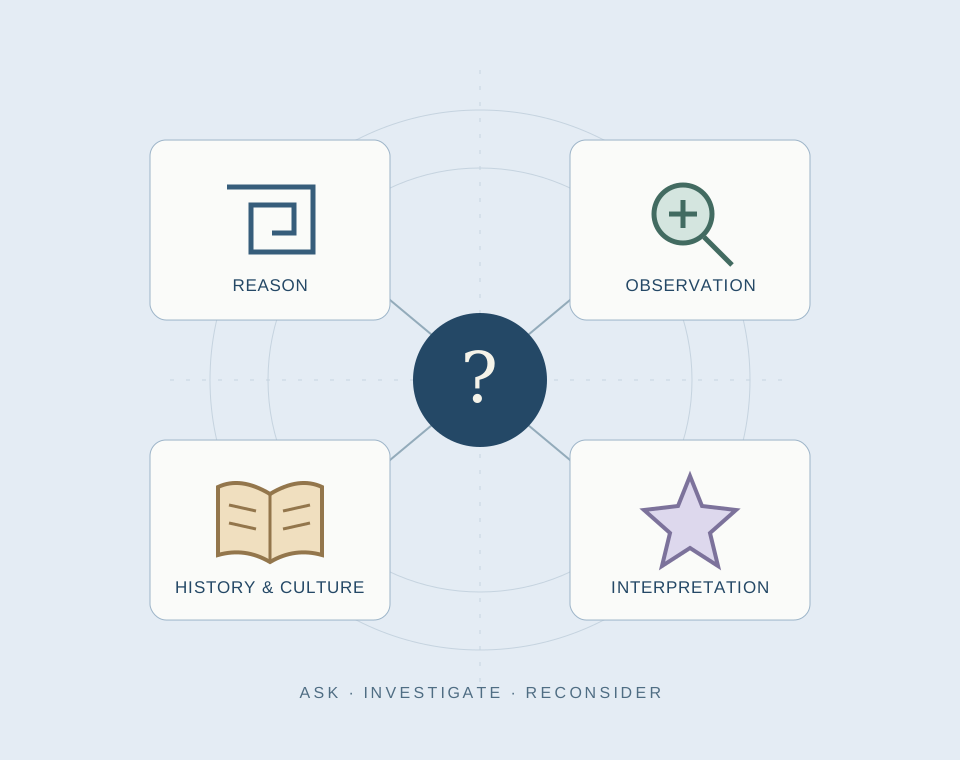
Work through a mystery as an investigator. Use reasoning to build an explanation, observation to check it, history to examine its context and interpretation to explore its meaning. Compare what each approach reveals and what it leaves unanswered.
The aim is to compare approaches thoughtfully: distinguish observation from explanation, examine a source and recognise when a conclusion reaches beyond its evidence.
THE APPROACHES
How is it connected?
Deduction, induction, inference to the best explanation and systems thinking. Build competing explanations and look for contradictions.
Where it can go wrongA coherent explanation can still start from a false assumption.
What can we actually check?
Observation, measurement, experiments and physical traces. Define a test, compare results and revisit the hypothesis.
Where it can go wrongAccurate observations still need context and interpretation.
What came before?
Documents, artefacts, interviews, oral histories and traditions. Compare sources and understand how an account was formed.
Where it can go wrongSources may be incomplete, mistaken or shaped by someone’s interests.
What does it mean to people?
Stories, symbols, intuition and ritual as ways people interpret experience. Examine meaning, expectations and alternative readings.
Where it can go wrongA meaningful interpretation is not, by itself, evidence that an event happened.
A TOOLKIT FOR INQUIRY
Use deduction, patterns and competing hypotheses. Ask which explanation fits the observations and what would count against it.
Define what to measure, what to change and what to keep constant. Compare the result with the prediction.
Bring together physical traces, people’s accounts and documents. Check who recorded a claim, when and in what context.
Look for confirmation bias, missing information and the temptation to mistake a coincidence or expectation for a finding.
ONE CASE, DIFFERENT QUESTIONS
ILLUSTRATIVE LEARNING SCENARIO
A glowing trail appears near an abandoned chapel. There are observations, local stories and several possible explanations.
Your task: build an investigation file. Record the reports, propose competing explanations, choose what to check and present a conclusion with its remaining uncertainties.
At the end, show your evidence map: which claims are observations, which are interpretations, which explanation is best supported and what you would investigate next.
WHAT YOU PRACTISE
PRACTICAL QUESTIONS
An investigation file, an evidence map and a conclusion that explains the reasoning, the limitations and the questions still open.
Apply different approaches to the same case. Compare the questions they ask, the sources they use and the conclusions those sources can support.
They help explore how people interpret events and create meaning. Factual claims still need to be checked against appropriate evidence.
BRING THE COURSE TO YOUR GROUP
Request the programme directly from its author. Tell me who will take part and what you want them to learn; we can discuss the scope and format for your group.
Request the programmeInclude your group size, learning goals and preferred dates.
Turn an idea into a playable game. Design the mechanics, build a prototype, test it with others and improve it through feedback.
Explore the course →